Good news from www.spaceweather.com.
CME IMPACT POSSIBLE THIS WEEK: On July 19th, a faint CME left the sun. NOAA analysts believe the plasma cloud could graze Earth's magnetic field on July 24th or 25th. A similar slow-moving CME hit Earth on July 13th, causing high-latitude auroras.
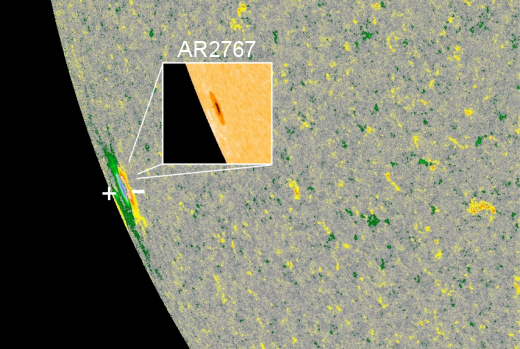
A NEW SUNSPOT: A sunspot has appeared and, according to its magnetic polarity, it is a member of new Solar Cycle 25. The sunspot's Earth-sized dark core is inset in this magnetic map from NASA's Solar Dynamics Observatory (see above)
This new spot is another sign of life from strengthening Solar Cycle 25. So far this year there have been 13 sunspots--ten of them (77%) coming from the new solar cycle. This compares to only 17% in 2019 and 0% in 2018. The sun is clearly tipping from one solar cycle to the next.
It is too soon to know if this new sunspot will become a source of solar flares. That depends on its magnetic complexity, which will reveal itself in the days ahead as the sunspot turns toward Earth.